[7 of 8] Ancient Principles for the 21st Century Entrepreneur – Internal Risk Management for Start-up

Into the Wilder{ness}with the children of Israel VIII

By Louise Lee

“By day the LORD went ahead of them in a pillar of cloud to guide them on their way and by night in a pillar of fire to give them light, so that they could travel by day or night.” Exodus 13:21, The Holy Bible

‘Pillar of Fire’ was the provision of God for the Children of Israel to go through wilderness by night, the purpose was to protect them from risk (potential danger), so that they could continue their journey onto the Promised Land (success).

We have established in the previous article that ‘pillar of fire’ principle represents ‘risk management’ for the start-up. And so far, we have covered the external risks that start-up may face. In this article, I am applying the ‘pillar of fire’ principle to the ‘internal risk management’.

What is ‘the internal risk’ for entrepreneurs?

I would like to define internal risk as anything that is potentially hindering YOU as a person.

Internal risk is anything that is potentially hindering YOU as a person.

Let’s look at it from a different perspective; internal risk can be interpreted as ‘personal crisis’.

Personal crisis if not managed properly will result in failure or collapse of anything you built, that include your family, relationships and business. It is especially critical in the start-up stage when ‘YOU’ are the key person. The logic is simple, when the key person is in crisis, your start-up is shaken, the impact is great.

When personal crisis hits you as a person, it can escalate quickly to become a risk for your start-up, which in turn risking your success. When the driving force behind your organisation is at risk, how can it move forward? The next question is: how to ensure this engine (YOU) is not overrun or is not getting into crisis mode?

Let’s look at some of the potential areas or indicator of internal crisis/risk. Personal crisis often appears in the form of ‘lack’: Lack of knowledge, lack of discernment, lack of confidence, lack of vision and lack of resilience; these are the hollow points in YOU.

Personal crisis often appears in the form of ‘lack’: Lack of knowledge, lack of discernment, lack of confidence, lack of vision and lack of resilience; these are the hollow points in YOU.

Do not let them hinder you but manage them before they hurt.

Manage Your Lack

How to manage your lack? These ‘lack’ are hollow points, the best way to manage it is to fill them with the right material and right actions.

What to do when you lack knowledge? You need not to be very knowledgeable before you can get your start-up on track, but you need to have some basic knowledge of many things. They are your trade or industry, accounts, law, finances, marketing methods, technology… etc. Acknowledge your lack is the first step, fill the lack with “know-how” is important.Be an all-rounded person, this can help you along the path to success. If not, engage the help of experts or more experienced individual if you can afford. If you can’t afford, just learn the bare minimal of everything essential to your business. Read up, take up courses are some low-cost way of becoming knowledgeable.

The most effective way could be finding yourself a mentor or join a community of like-minded people.

“In a company of three, you will find a teacher you can learn from.”A Chinese Proverb

What to do when you lack discernment? You may want to listen to your wife/husband or counsels you tend to ignore. For believers, listen to the inward witness and the voice of the Holy Spirit and ask for discernment.

The ability to discern about timing and what action to take is critical for start-up. Missed opportunity is one of the results of lack of discernment. If you lack discernment, surround yourself with mature and reliable counsels. For believers, ask your Heavenly Father for wisdom. Do know that discernment is one area that you need to work on and pay close attention to.

What to do when you lack confidence? Acknowledge your lack and check for its root. Don’t be surprised that even into your adulthood you may still be seeking approval from authorities that you did not get while growing up.

So, be very careful to check your motive: why you are doing what you are doing. Are you doing these out of fear, insecurity or approval seeking? Try your best to uproot them before they get into your way of success.

Beware! Do not ignore the sign of lack in confidence. The collapse can be great if its roots are to discover later than now.

What to do when you lack vision? You may ask if it is important to have vision. The answer is a definite yes! You need to see at least 2 to 3 years down the road where you see yourself and your start-up, you will then know the next series of action to take.

Once you’ve established your vision, write it down, draw it out, make it bold, hang it somewhere at your work area and look at it constantly. If you can, look a little further about 5 to 10 years ahead, adjust whenever it is necessary.

“Without vision, people perish.” Proverbs 29:18, The Holy Bible

 What to do when you lack resilience? Are you the type that is easily discouraged? Do you find yourself always like a punctured balloon?

Watch your self-talk. Perhaps you are talking to yourself too harshly or you are allowing other people’s words to discourage you.

Be in the accompany of encouragers. Stay away from the negative people.

Refine your purpose and tighten the loose ends. Affirm yourself the purpose and tell yourself you can overcome. Practise your self-talk that affirms and be flexible.

A nugget for the lack of resilience: Be flexible otherwise you will break.

Next time when crisis hits, you can bounce back easily.

Turn your ‘lack’ into arches

Managing these ‘lack’ is critical during start-up especially you can’t see results immediately.

Imagine if you build a structure on top of a hollow ground, when pressure comes, the collapse is great.

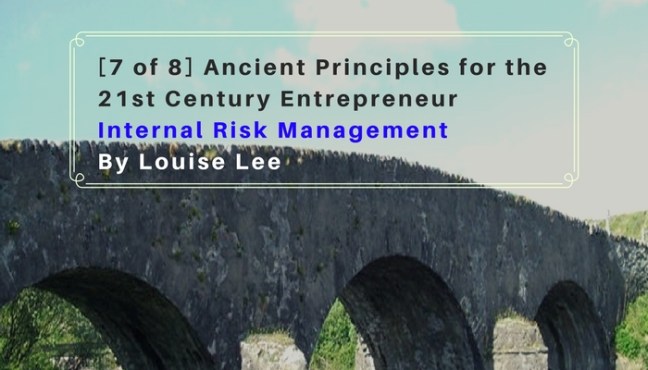
Managing your lack is like turning the hollow space into an arch, which allows it to support the pressure from on top.

Bridges are built on arches joint below, which can sustain great pressure above with thousands of cars coming through daily.

You are the architect of your start-up, spare a little thought over your ‘lack’, turn them into arches by applying the principle of “Pillar of Fire”.

In application to entrepreneur’s start-up journey, identify your ‘internal risk’ or ‘lack’ before you build anything on top. This step is important, remember the ‘pillar of fire’ lights the way in dark, this allows the Children of Israel to identify the potential danger, this safeguard their journey towards the Promised Land.

Last but not the least, be well-versed of your own lack, work hard to turn them into strength, you will see success rather than unexpected collapse along the way.

Stay tuned for the next and final article in the series:

Ancient Secrets for the 21st Century Entrepreneur: “NO TURNING BACK”!


[2 of 8] Ancient Principles for the 21st Century Entrepreneur

The Manna Concept – Don’t Get More Than You Need

Into the Wilder{ness}with the children of Israel III

By Louise Lee

“The “Manna” concept in the start-up journey represents the small but just enough opportunities that get every entrepreneur going. The origin of these opportunities is divine, but you need to work hard to consolidate and make good use of them. The discipline of doing small things every day enriches your experience, sharpens your skills and boosts up your confidence” ~ Louise Lee, Ancient Principles of the 21st Century Entrepreneur

The environment for the new entrepreneur might be harsh, but there is a divine supply of opportunities (Manna) along the way; the start-up experience is likened to the wilderness experience of the children of Israel as recorded in the Holy Bible.

In this article, I will carry on with the manna concept and its application in the start-up journey. If you recall, there are “dos and don’ts” regarding the collection of “Manna”…

1. (Do collect everyday) The children of Israel had to collect them every day – early in the morning after the dew laid on the ground. Each one was to collect as per their needs.

2. (Do not collect more than you need) There was no use to collect more, the extra manna would breed worms and stink.

3. (Do collect more when there is a double portion supplied) The only day they would have double supply was on Saturday.

4. (Do not work when you need to rest) There was no manna to collect on Sundays.

I would like to focus on the don’ts in the manna concept in the following paragraphs.

Passion First

The first few years of your start-up are crucial as they determine how far and how long you will go in a certain direction. It is important to set it right from the start. It is also important to make corrections if it does not align with the main course, or what you set out to do.

Did you know that if you do not have a vision or a long-term plan, your needs will drive your business? You might be ended up like a hamster running on the wheel, or running the same rat race, the one that you hated most when you were an employee.

Do you have a plan? How long is your plan? One year, two year, or six months…? It is essential to have at least a five-year plan, and maintain a flexible one year plan and review it every six months. If you haven’t gotten any of these yet, please find time and set them in place before you go any further. You will not regret doing this because this will save you a lot time and effort, as it helps steer your business towards the right direction. Write your plans and your goals down and paste them somewhere you can see every day.

Frist, your plans should align with your passion, your vision, and they shall become your motivation when the going gets tough.
Partridge Publishing
“It is obvious that we can no more explain a passion to a person who has never experienced it than we can explain light to the blind.” -T. S. Eliot

I find this quote a powerful illustration to describe passion. If passion is light to the blind, you would need to have a passion in what you are doing in your business. Passion helps you prioritise your opportunities, make the right selections, and keep you on track with your goals.

Passion with vision is a powerful team to bring you success. Vision is about the future of your business; it is somewhat like a goal but it is visual. It is also the big picture that guides your goal setting. In this sense, your goals are the lamp posts that lead you along the way towards the big picture. Passion ignites with vision makes your business a powerful rocket. The profit you make from your business will surely be put into good use if you have a vision, or a cause or a solution you see to the problem you felt strongly about.

Does “a passionate entrepreneur of … ” describe you? If your answer to this question is yes, congratulation! You shall see your success. If you have no answer for this question yet, spend some time to find that out because it is the key to your success. Only then the rest of the effort will make sense, it is also the only way to get you out of the hamster wheel!

Ploughing of Ground

Whatever you do in the early stage of your business is an act of ploughing, the ground could be hard and it might be harder than you have imagined. Ploughing is different from planting seeds; the key distinction is that you do not expect a harvest when you plough the ground. Like it or not, you are only ploughing grounds in the first few years of your new business. That is also why your opportunities come in piece and pieces and they are small by nature. They are not significant in the sense of value but they are significant in the way that they can help to identify your strengths and weaknesses.

In fact, if we look closer at this ploughing stage, the ground is not anywhere outside, but inside your heart. Each opportunity shows up to confirm what you have in your heart, and only those stay on and became the seed for your planting later. So, when opportunities come, make it a time to differentiate your passion from your needs.

Answer this question honestly: Is it your passion or your need(s) that drive you?
Partridge Publishing
Managing your needs

What do you need? Recognition, a sense of significance, respect, money, freedom, success, a sense of achievement are all legitimate needs, but if these are all that drive you on the path of entrepreneurship, you are only running on the treadmill. Likely, you are not going anywhere significant. You may have wondered why you live a life that is not much different from being an employee; or now it is worst because the stress level is much higher that you must constantly look for business opportunity, rather than waiting for the month end pay check.

How is the life of an entrepreneur different from that of an employee anyway? Why did you take a step out doing what you are doing right now?

Don’t be surprised that what set you out might not be what drives you now. So, constantly we need to have a conversation with ourselves. If you are honest enough, you will have some answers. Make sure your business is fuelled by your passion, and you are here for the long haul.

Do not take more than you need.

Now, let us get back to the “DON’T”s of entrepreneurship: Do not take more than you need. What is your business’ basic need? How much business or profit you need to survive? How much do you need to sustain your business? All these determine how much opportunities or jobs you should take on at the minimum.

Partridge Publishing

You need to be selective. Choose what brings you satisfaction and happiness. Once you get your hands in doing some of the new jobs (opportunities), you should know if that aligns with your passion or not. If it is not, do eliminate them in your future endeavours. Nevertheless, there is no hard and fast rules to tell what jobs guarantee satisfaction, but if you like, you might work on the guideline of three: Work on maximum three niches at one time and spend some time working through them, and to identify one that brings you the most satisfaction, then focus your energy to develop that niche. Be open and prepared to work hard, and prepare for changes. You might be one of be those talented individuals that could manage three niches and be successful in all of them, but it might be rare! So, stay focus on one or two but not more than three at one time.

Why should you be selective? Consider this: if you are not, you might end up getting too much to do that you are working around the clock and making very little profit or progress. Remove some of the unproductive jobs that bring in the least profits. Remember to keep your work-life balance as the entrepreneur’s journey is long, you need to reserve your energy. Remember to set your five-year plan, and set goals to achieve it. Any plan that is shorter than that will not be sufficient to steer your entrepreneurship journey right.

Do not work when you need to rest.

Six days you should work, and give yourself at least one day to rest in a week. It is kind of strange when we worked for people, we demanded from our ex-employer overtime pay, annual leave, sick leave, benefits, bonus, etc., but when we start on our own, we become very lenient on ourselves concerning worker’s benefits. Let’s face it, you are the only worker in your start up, do consider the benefits in a reasonable term. Then, when your company grows bigger, the principles you apply on yourself will expand to those who work for you in the future. Work within your means and that includes your time, and your mental and physical capacity, remind yourself that you are no transformer or superhero. So, don’t be too lenient in demanding yourself an employer, and don’t be too hash on yourself as a worker. Rest well and it will benefit you for the rest of the work week, work years and the rest of your entrepreneurship journey.

Conclusion

In conclusion, the ancient advice in handling our entrepreneurship journey is wise and helpful. They are gold and still applicable today in the 21st Century when knowledge is available from all directions that provide plethora of opportunities. The “DON’T”s guide our process of selection and decision making. Ultimately, no one can be a superhero because we all have limits. We are limited by our mental capacity, physical capacity, experience and resources, do work within these limitations and not to overstretch at the early stage of entrepreneurship. Of course, passion and vision is the team that will help you overcome your limitations and give you the breakthroughs your need, do recruit them early in your journey!

Coming up next is the personal branding principles – inspired from the never worn out clothes of the Children of Israel.

Partridge Publishing

[3 of 8] Ancient Principles for the 21st Century Entrepreneur

3 of 8

Building a Personal Brand that Lasts

Into the Wilder{ness}with the children of Israel IV

“… During the forty years that I led you through the wilderness, your clothes did not wear out, nor did the sandals on your feet.” Deuteronomy 29:5, The Holy Bible

If the experience of being in the wilderness were like the entrepreneur start-up journey, what would the never worn-out clothes be?

To answer this question, we need to look at some characteristics of the never worn-out clothes especially its never-worn-out nature.
Partridge Publishing
First, clothes are for the external or for the outside world to see. As an entrepreneur, “clothes” could mean the image we put before others. In other words, it is the personal branding that we present before the world. Coca-Cola, Disney, MacDonald’s, Apple, Facebook just are some of the examples of popular brand names that are of this nature. Many started as personal brands and today these are the representation of great corporations and platform that nurture many other brands, yet retaining the iconic original personal brand with a niche.

What can we learn from here? Personal branding can be last if this is established and set right at the early stage. The entrepreneur’s start-up stage is crucial for the establishment of this personal branding. Whether you like it or not, a personal brand sticks with you for the longest time. So, let us examine further what a personal branding entails.

Debates have always been on ‘nature’ or ‘nurture’ and how these two influenced a person’s development and success rate; this debate has made these two processes rather incompatible to some extent. However, when we apply ‘nature’ and ‘nurture’ in building personal branding, they need not be incompatible options. Rather, personal branding should be a combination of the two and it becomes a formula like this:

NATURE + NURTURE = PERSONAL BRANDING

‘Nature’ is what was given since birth or inherited from your parents. In business sense, it could also mean your business DNA that you inherited from your mentors or the influencers in your life. ‘Nature’ also includes your basic personality and natural inclination towards a field or an expertise in an industry. Without this inclination, you would not feel drawn to this field or industry. To some, it could mean a calling in life or the giftedness they recognized; it could mean also the life opportunities opened for them.

Next, ‘nurture’ is what you gathered and get yourself trained up in on top of what was given (nature). You may have a family of musicians, but if you do not cultivate your life musically, your family history does not form part of your personal brand. ‘Nurture’ includes your knowledge, credentials, working experience and connections, or things that you have been building for years.

Second, personal branding is not fashion. No fashion can last, trends come and go, fashion by nature is meant to last only for a short time. Some fashionable style might be able to make a comeback, but the fact is that no fashion styles are everlasting. So, when you are determining your own branding, be careful not to just do what is trendy; trendy stuffs last only for a moment, if you want a lasting success, a non-fashionable idea is better than a fashionable one. To discover the seed is important than the fruit, as the seed the where the continuing power being stored. For example, the success of one social media is not its brand name, but it is the user experience they offer. Without deciphering the seed (user experience) from its fruit (successful brand name), it is not going to be useful to land you into the success you desire.

Third, personal branding cannot be purchased. Building a personal brand is not an easy task, it takes observations and understanding for an extended period. If you are considering buying a brand name and make it your own, the chance of it having the same tenacity of the original brand is rare. This strategy seems to work only for beating competition, but it can never be your personal branding strategy.

Partridge Publishing

The originality of a brand is one that stems from something that money cannot buy. Money cannot buy passion, creativity, character, integrity, experience, credibility and resilience. A personal brand that are built upon these qualities are one that lasts. It takes a careful observation and adjustments to reach its full potential.

Last but not the least, be sure to build a personal brand that is expandable or that allows future expansion. By nature, anything personal or unique will also set its limitation. A niche is good for a start-up, but if it is narrow and rigid, then it is not expandable. For example, you are in a training business, you might have a niche on communication, your personal branding ought to be above the niche that you might expand to the field of social entrepreneurship later.

So, if you position your personal branding on your skill sets rather than special field, you are making your personal branding expandable. It is always good to ride on skills rather than filed or industry, because after sometime when you have exhausted the specific avenue, you can always expand your training business into the more profitable market without sweat.

Overall, it is a delicate balance between being a generalist or having a careful-thought-through personal brand. To work within a niche and yet not limited by it is a tricky business; however, it is possible if you pay attention during the start-up stage of your entrepreneurship journey, look out for those elements that are persistently staying strong and keeping you successful. Remember you are building a personal brand or brand that lasts and it is also the “never-worn-out clothes in the wilderness”.

After all the internal building of discipline of the small things (Manna), now it is time for the external – a personal brand that lasts. After discovering the personal brand, you ought to establish something that keep you constantly on the go and that is to wear your “never-worn-out shoes”.

In the next article, the hidden principles relating to the “never-worn-out shoes” will be explored, stay tuned!

Partridge Publishing